
Skip to content
YantraManiaBuild. Compete. Inspire.

Pune 2027 · Get ready to build

Team registration · Date and venue to be announced

Prepare. Compete. Play fair.

Tournament rules & scoring.

Understand eligibility, robot safety, scoring priorities and fair play for YantraMania Pune 2027.

2027 participant guidance

Read the baseline. Check the final rulebook before building.

These rules summarise the supplied 2027 tournament guidance and the current team, entry-fee and controller policies. Run timings and arena references are provisional. Percentage weightages, numerical penalties and missing task-point values are awaiting the final rulebook.

More makers. More possibilities.

One free team per category, per school.

Every competition category requires a team of 2 to 3 students. Each school receives one free team entry in each competition category, across divisions.

Additional teams from the same school and all independent entries: INR 600 per team.

General tournament rules

Grade 3–5Grade 6–8Grade 9–12Open

Team and division

  • Teams contain 2 to 3 students, with a registered adult coach or coordinator.
  • A student may compete in only one main-event team on tournament day. Each team enters one main competition.
  • A registered robot may not be shared between teams.
  • The highest school grade represented in the team determines its school division. Open entries require approval.
  • A separate championship podium requires at least four teams in a division. Smaller divisions may be merged operationally with a suitable neighbouring division, with possible age-band recognition.

Student ownership

  • Robots must be built or assembled by the students. Adults may mentor before the event, but must not drive, code, repair or tune the competition robot during controlled competition periods.
  • Students should be able to identify their controller, explain a sensor and a code decision, and describe who built, programmed and tested each part.

Technology and safety

  • Only Arduino (standard or protected variant) and ESP32 in a protected version are allowed. Declare the controller and sensors before inspection.
  • Raspberry Pi, Jetson, Linux or laptop-class single-board computers, advanced camera-AI / edge-AI compute modules and unprotected ESP32 boards are not allowed.
  • Typical sensors include IR, ultrasonic, colour/light, encoders, IMUs and switches. Mechanical parts may be commercial or fabricated unless an event rule restricts them.
  • No unsafe high-voltage systems, pyrotechnics, projectiles, sharp mechanisms, exposed dangerous wiring or damaged/swollen batteries.
  • Final size, weight, voltage and event-specific dimensions are awaiting the final rulebook.
  • Wireless control is permitted only where the event mode allows it. Autonomous robots must not receive external control during a run.

Inspection and readiness

  • Every robot must pass technical inspection before its first official run or match.
  • Correctable issues must be repaired and re-inspected before the announced deadline. Unsafe or prohibited hardware cannot enter an arena.
  • Material hardware changes that affect eligibility may require re-inspection.
  • Follow assigned reporting and arena call times. Keep the robot labelled and bring charged batteries, approved spares and basic tools.

Fair play

  • Do not deliberately interfere with another team or damage the field, another robot or a person.
  • Do not touch a robot after a run begins unless a referee authorises the reset or restart.
  • Abuse, cheating, unsafe conduct and misrepresentation of student work may lead to penalties or disqualification.
  • Spectators remain outside arena and pit barriers. Only authorised participants, coaches and officials enter controlled zones.

Reruns and appeals

  • Organiser field/equipment failure, timer failure or power loss may justify a rerun if result integrity was affected, subject to the published rerun rule.
  • Team battery, code or mechanical failures do not normally earn a rerun. Spectator noise alone is not grounds for a rerun.
  • Only the registered student captain or coach may appeal, within the announced window after the provisional result or incident.
  • An appeal should identify the team, event, relevant rule, incident and requested remedy. Use the designated appeal point rather than disputing at an active arena.
  • Decisions use the written rules and official observations. Spectator recordings are considered only if accepted by the tournament officials.

Know what counts

Category rules & score calculations

Ranking priorities compare criteria in sequence; they are not percentage weightages. Soccer league points have a specified calculation. The other categories require the final task values and penalties before a complete numerical score can be calculated.

2027 scoring guidance · SmartTrack

Rules & scoring

AutonomousFinal scoring values pending

Document baseline: up to 180 seconds per run. The final rulebook may change this limit.

How the score determines ranking

Compare completion or mission status first, penalties second, then elapsed time. Within equivalent completion and penalty results, the faster valid run ranks higher.

Line Follower scoring criteria and calculation
CriterionCalculation / priority
Completion / mission statusFirst ranking priority; the exact status hierarchy is awaiting the final rulebook.
PenaltiesSecond ranking priority; numerical values are awaiting the final rulebook.
Elapsed timeThird ranking priority; faster is better after the earlier criteria are applied.

During your run or match

  • Start fully inside the start box, with hands off before the countdown.
  • No external control after the start.
  • Touching or resetting the robot requires referee permission and must follow the published reset rule.
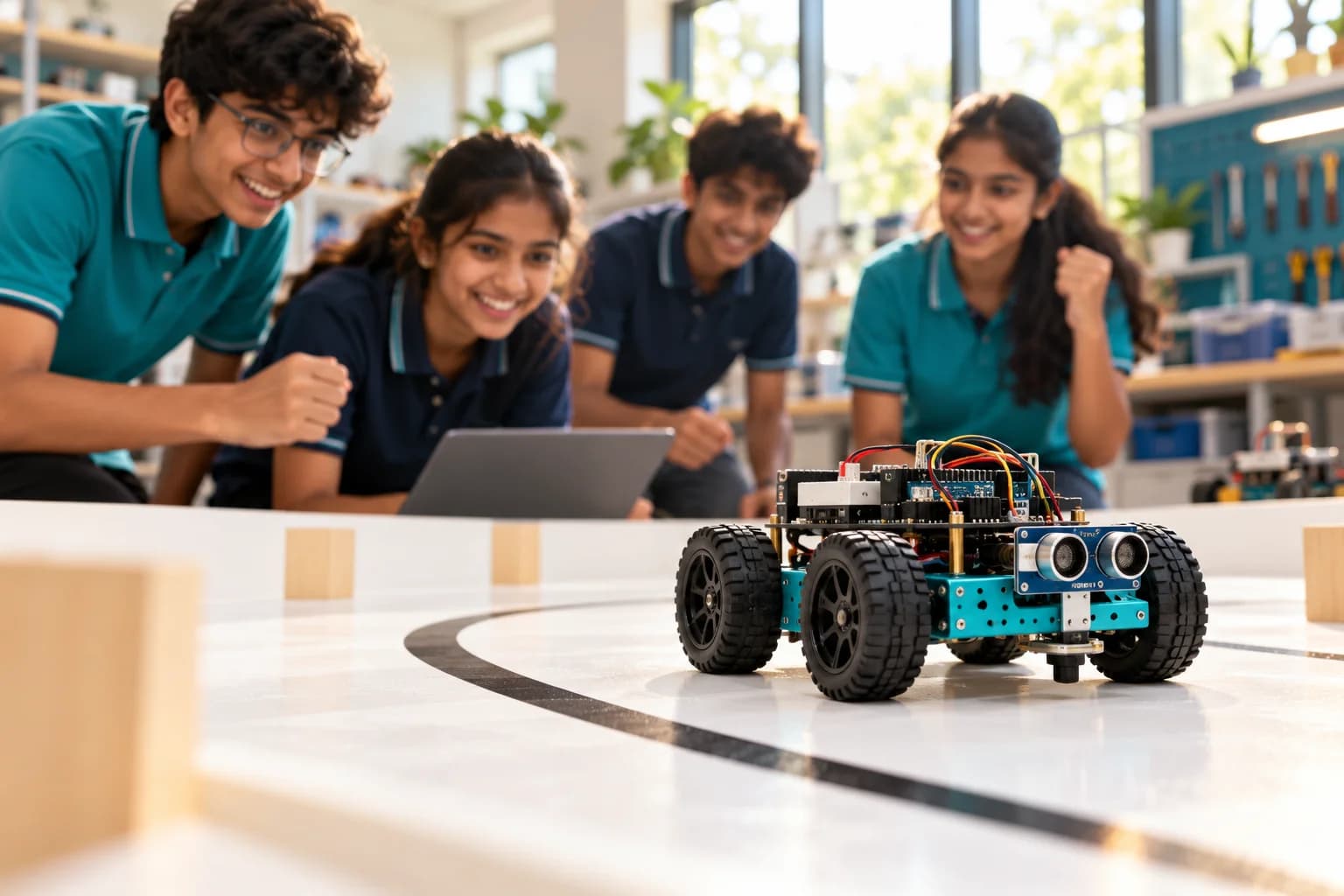
  • The reference field is a matte white base with a nominal 25 mm black line; final arena dimensions are awaiting the rulebook.

Awaiting the final rulebook

The supplied guidance does not define percentage score weightages or a complete weighted-score formula. No percentage weights have been assigned.

  • Number of attempts and best-run selection
  • Exact start / finish timing definition and completion categories
  • Line-loss, contact and reset penalties; restart conditions
  • Final track dimensions and tie-break procedure

Obstacle Challenge

Explore the category →

2027 scoring guidance · RescueSort

Rules & scoring

Autonomous / task basedFinal scoring values pending

Timed mission; the run limit is awaiting the final rulebook.

How the score determines ranking

Mission points come first. Penalties and elapsed time resolve ties according to the final rulebook; their exact sequence and calculation are not yet specified.

Obstacle Challenge scoring criteria and calculation
CriterionCalculation / priority
Obstacle navigationCheckpoint success and contacts are recorded; point values are awaiting the final rulebook.
Object pickupCorrect acquisition without prohibited hand assistance; point values are awaiting the final rulebook.
TransportCarry or control the object to its destination; point values are awaiting the final rulebook.
Sorting / dropCorrect object in the correct target zone; point values are awaiting the final rulebook.
Completion / returnFinal-zone or return task applies only if included in the final rulebook.
Penalties / elapsed timeTie-break criteria; values and order are awaiting the final rulebook.

During your run or match

  • Navigate the course and complete object-handling tasks without unauthorised hand assistance.
  • Objects must reach their correct destination zones to satisfy sorting/drop tasks.
  • Object positions and field configuration are consistent for official attempts within each division.
  • Younger divisions may use fewer obstacles or objects; final division layouts will be published.

Awaiting the final rulebook

The supplied guidance does not define percentage score weightages or a complete weighted-score formula. No percentage weights have been assigned.

  • Points and any weightage for each mission element
  • Object count, dimensions, sorting criteria and arena layout
  • Run limit, attempts, resets and numerical penalties
  • Tie-break order and any treatment of time in the score

2027 scoring guidance · RoboRush

Rules & scoring

Driver controlledFinal scoring values pending

Individual timed qualification runs are the document baseline. Run limits and later rounds are awaiting the final rulebook.

How the score determines ranking

The fastest valid course completion after applying the published penalties ranks highest. The penalty calculation method is awaiting the final rulebook.

Robo Race scoring criteria and calculation
CriterionCalculation / priority
Valid course completionComplete the permitted route and checkpoints; validity conditions are awaiting the final rulebook.
Elapsed timeFaster valid completion is better.
Course penaltiesMissed gates, obstacle bypass, hand reset and course departure are recorded separately; numerical values and how they affect time are awaiting the final rulebook.

During your run or match

  • Only the designated driver, officials and authorised marshals enter the active race zone.
  • Do not bypass obstacles or miss required gates.
  • If the robot stalls, the clock continues to the run limit unless the published rule permits a reset.
  • A robot leaving the safe course boundary or creating a hazard is stopped.
  • Stay in the designated driver position; field entry requires referee permission.

Awaiting the final rulebook

The supplied guidance does not define percentage score weightages or a complete weighted-score formula. No percentage weights have been assigned.

  • Run limit, number of qualifying attempts and best-run selection
  • Penalty amounts and whether they adjust time or use another method
  • Reset allowance, course dimensions and checkpoint definitions
  • Qualification cutoffs, final format and tie-break procedure

2027 scoring guidance · RoboKick

Rules & scoring

Driver controlled · head-to-headFinal scoring values pending

Document baseline: two 2-minute halves, with a 1-minute half-time break.

How the score determines ranking

Goals determine the match outcome. Group league points = 3 × wins + 1 × draws + 0 × losses. Group tie-break order and knockout draw resolution are awaiting the final rulebook.

Robo Soccer scoring criteria and calculation
CriterionCalculation / priority
Win3 league points per match won.
Draw1 league point per drawn match.
Loss0 league points per match lost.
Equal group points / knockout drawTie-break, extra-time or penalty-challenge procedure is awaiting the final rulebook.

Example: 2 wins, 1 draw and 1 loss = (2 × 3) + (1 × 1) + (1 × 0) = 7 league points. These are match points, not percentage score weightages.

During your run or match

  • Group fixtures are followed by knockout matches where feasible; advancement details will be published.
  • Restart from the centre after a goal; use the designated boundary/out-of-play restart.
  • Normal robot contact is expected, but ramming, pinning and unsafe mechanisms are penalised.
  • Drivers stay in the designated technical box and enter the field only on the referee’s signal.
  • Use wireless control only as permitted for this event.

Awaiting the final rulebook

The supplied guidance does not define percentage score weightages or a complete weighted-score formula. No percentage weights have been assigned.

  • Field and goal dimensions, ball specifications and robots per side
  • Possession limits, foul penalties and restart details
  • Group tie-break order and advancement criteria
  • Extra-time / penalty-challenge procedure for knockout draws